


AR1041 MIMO Yagi Antenna Dual Polarization +/-45deg 1710-2170 MHz
MOD. AR1041.1YQ - MIMO
High-gain directional MIMO Yagi with dual polarization (+/-45deg) and two independent outputs, engineered for tunnel radio coverage and controlled portal/end-over links.
Frequency range: 1710-2170 MHz (DCS/LTE/UMTS, 5G-ready deployments according to the project band plan)
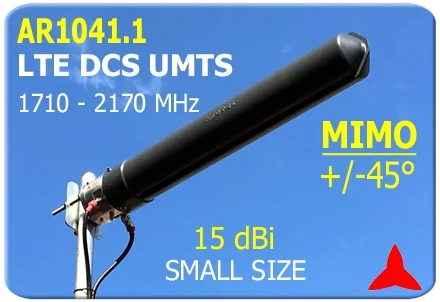

Directional MIMO Yagi for tunnel and portal coverage (1710-2170 MHz)
The AR1041.1YQ is a high-gain directional broadband antenna designed for modern multi-technology radio coverage in the 1710-2170 MHz range. This spectrum is widely used for DCS/LTE services around 1800 MHz and UMTS/LTE services around 2100 MHz, and it is frequently considered within 5G-ready deployment plans where the same bands are reused or refarmed according to the operator strategy.
In tunnel environments (railway, high-speed lines, motorway and road tunnels, metro and underground sections), propagation is dominated by reflections, long corridors and portal transitions. A controlled directional pattern helps shape the serving area, while the dual polarization (+/-45deg) with two independent outputs supports MIMO architectures and improves link robustness and throughput in confined spaces.
Typical applications in tunnel infrastructures
- In-tunnel radio coverage for continuous service along long galleries and underground corridors.
- Portals, end-over and transition zones where the radiation pattern must be controlled to manage coverage continuity between outdoor and underground sections.
- Donor links for repeaters or DAS architectures, where directional capture of the serving cell is required at outdoor positions.
Mechanical protection and safety-oriented materials
The antenna is built with a protective fiberglass cover to shield the structure against shocks and harsh weather conditions, and all metal parts are D.C. grounded for lightning protection. For projects with additional safety-driven material requirements, a flame retardant fiberglass radome option is available, supporting tunnel procurement frameworks without compromising the antenna radiation behavior.
Antenna designed and manufactured in Italy.

Frequently asked questions about AR1041
Key questions from system integrators and operators about tunnel coverage, portal links and donor architectures using the AR1041.1YQ.
Which bands and technologies are typically supported in 1710-2170 MHz?
Why use dual polarization (+/-45deg) for tunnels?
Can AR1041 be used at tunnel portals (end-over / transition zones)?
Is AR1041 suitable as a donor antenna for repeaters or DAS?
Is a flame retardant fiberglass radome available?
How is lightning protection handled?
Related topics and searches
Typical queries and applications related to the AR1041 and similar Protel tunnel antennas:
tunnel MIMO Yagi antenna +/-45deg 1710-2170 MHz tunnel antenna DCS 1800 LTE tunnel coverage antenna UMTS 2100 directional antenna high gain donor antenna for repeaters and DAS tunnel portal end-over pick-up antenna flame retardant fiberglass radome tunnel 5G-ready 1800 2100 MHz MIMO antenna