


RIP2.1WN / RIP3.1WN / RIP4.1WN Broadband Splitters 700-2700 MHz for LTE GSM DCS UMTS
RIP2.1WN / RIP3.1WN / RIP4.1WN
Broadband RF splitters 700-2700 MHz for professional signal distribution in LTE/4G/5G (DSS), GSM, GSM-R, DCS and UMTS networks.
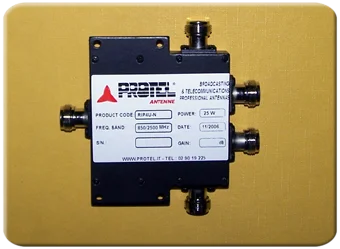
RIP2.1WN - TWO-WAY SPLITTER
Frequency range MHz 700÷2700
Bandwidth MHz 2000
Impedance 50 Ω
Return loss (VSWR) -dB typ. 700-1000 MHz 20 (1.22:1) / 1700-2200 MHz 20 (1.22:1) / 2200-2700 MHz 18 (1.28:1)
Split / Insertion Loss dB 700-1000 MHz 3 / 0.1 - 1700-2200 MHz 3 / 0.3 - 2200-2700 MHz 3 / 1.3
Connector Nm
Max Power 50 W
Nominal temperature range -40°C to +65°C
Color Black anodized
Dimension mm 100 x 55 x 20
Weight Kg 0.110
RIP3.1WN - THREE-WAY SPLITTER
Frequency range MHz 700÷2700
Bandwidth MHz 2000
Impedance 50 Ω
Return loss (VSWR) -dB typ. 700-1000 MHz 23 (1.15:1) / 1700-2200 MHz 22 (1.17:1) / 2200-2700 MHz 24 (1.13:1)
Split / Insertion Loss dB 700-1000 MHz 4.5 / 0.2 - 1700-2200 MHz 4.5 / 0.3 - 2200-2700 MHz 4.5 / 0.7
Connector Nm
Max Power 50 W
Nominal temperature range -40°C to +65°C
Color Black anodized
Dimension mm 120 x 55 x 20
Weight Kg 0.130
RIP4.1WN - FOUR-WAY SPLITTER
Frequency range MHz 700÷2700
Bandwidth MHz 2000
Impedance 50 Ω
Return loss (VSWR) -dB typ. 700-1000 MHz 20 (1.22:1) / 1700-2200 MHz 20 (1.22:1) / 2200-2700 MHz 18 (1.28:1)
Split / Insertion Loss dB 700-1000 MHz 6 / 0.2 - 1700-2200 MHz 6 / 0.2 - 2200-2700 MHz 6 / 0.4
Connector Nm
Max Power 50 W
Nominal temperature range -40°C to +65°C
Color Black anodized
Dimension mm 140 x 55 x 20
Weight Kg 0.200
The RIP2.1WN, RIP3.1WN and RIP4.1WN are compact broadband RF splitters engineered to distribute signals across the 700-2700 MHz range. They are typically used as distribution elements in cabled cellular systems, including DAS and repeater-based networks, where stable matching, low losses and predictable branch behavior are essential.
This frequency span supports many of today’s operational services: LTE/4G and 5G (DSS) deployments in 700/800/900/1800/2100/2600 MHz bands, as well as legacy and hybrid ecosystems such as GSM, GSM-R, DCS and UMTS. The upper portion of the band also includes the 2.4 GHz ISM range, useful for Wi-Fi and telemetry distribution where a shared RF infrastructure is required.
Designed for professional installations, these splitters are small, light and cost-effective. They can be installed directly on a mast with a lock ring (not supplied) or fixed on a wall using the existing mounting holes, helping keep layouts clean in technical rooms, equipment cabinets and coverage infrastructures.
Select 2-way, 3-way or 4-way versions according to the number of branches and the desired power distribution. High isolation and controlled return loss support clean operation and reduced interaction between outputs, improving consistency in multi-branch coverage networks.
Frequently asked questions about RIP2.1WN / RIP3.1WN / RIP4.1WN
Quick answers to help you choose the right broadband splitter for LTE/4G/5G (DSS), GSM, GSM-R, DCS and UMTS distribution networks in the 700-2700 MHz range.
What is the difference between RIP2.1WN, RIP3.1WN and RIP4.1WN?
Which services can be distributed in the 700-2700 MHz range?
Are these splitters suitable for DAS, repeaters and micro-repeaters?
Can the splitters be installed on a mast or on a wall?
Which connectors are used?
Why are return loss and isolation important in a splitter?
Related topics and searches
Typical queries and applications related to the RIP2.1WN / RIP3.1WN / RIP4.1WN and similar Protel RF components:
700-2700 MHz RF splitter 2-way 3-way 4-way power splitter LTE 700/800/900 distribution DCS 1800 UMTS 2100 splitter LTE 2600 4G 5G DSS components DAS in-building RF distribution tunnel and metro coverage networks high isolation low insertion loss splitter N male 50 ohm RF splitter